
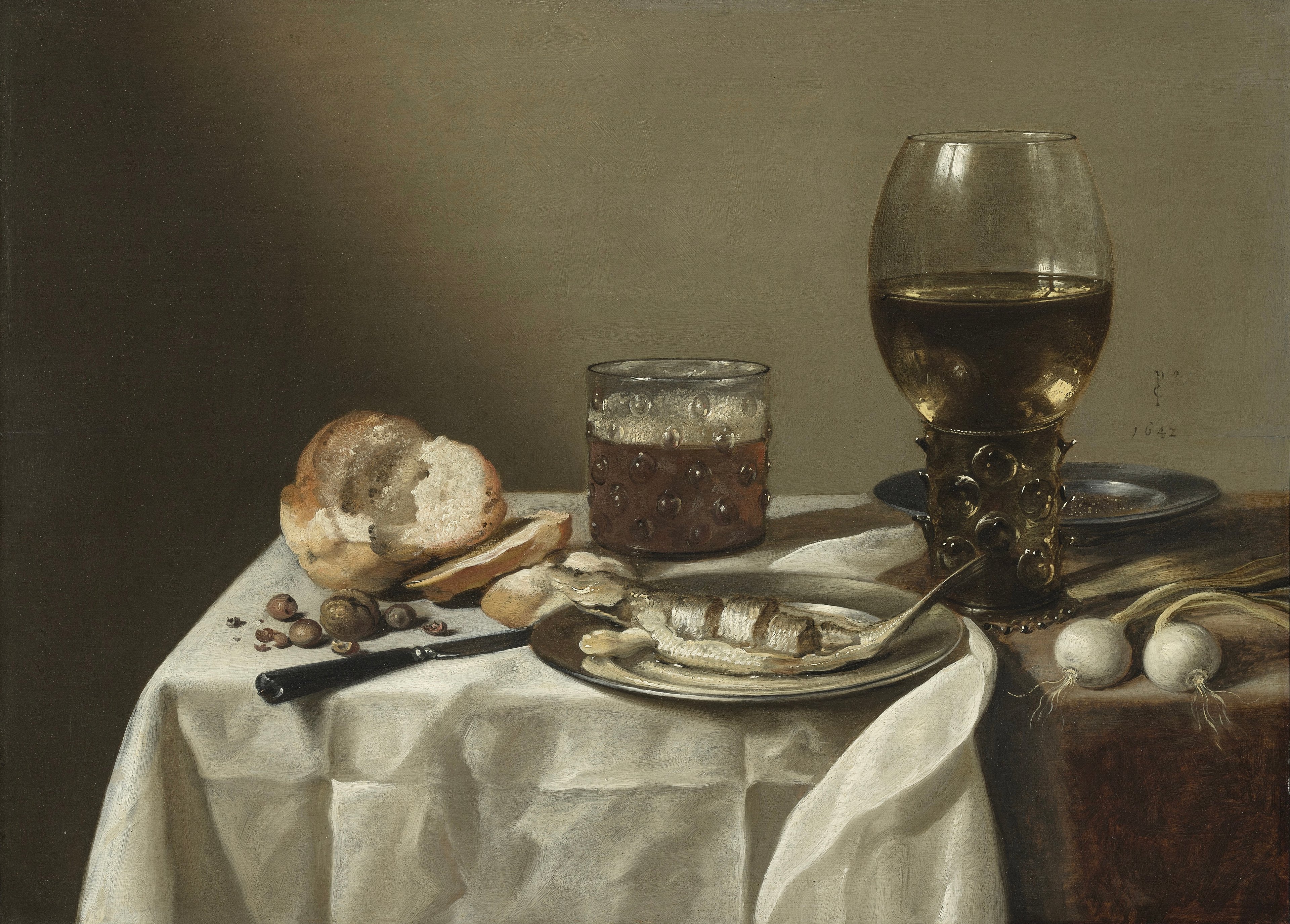
Simplicity in Grey and Ochre
Herring with onions, bread, and beer form a simple Dutch meal known as onbijt. In Pieter Claesz’s time, the term referred not only to breakfast, but also to a light meal that could be eaten at any time of day. Beer was an everyday drink, not least because drinking water was often of poor quality. Herring was likewise a staple food for the Dutch population and also played an important role as a food eaten during periods of fasting. It was caught in large quantities, salted at sea, and preserved in this way.
Salt was therefore essential not only to the fishing industry, but also to the Dutch economy as a whole. It was also needed to preserve meat and bacon and to produce butter and cheese. As domestic salt supplies were insufficient, the Netherlands imported salt from various regions of Europe and, later, from overseas. The seemingly unremarkable herring on the table thus points to an extensive network of trade and commerce that played a significant role in the rise of the Netherlands as a maritime power.
Film Recommendation
Monochrome Banquet: Find out more about the use of colour accents in this painting.