
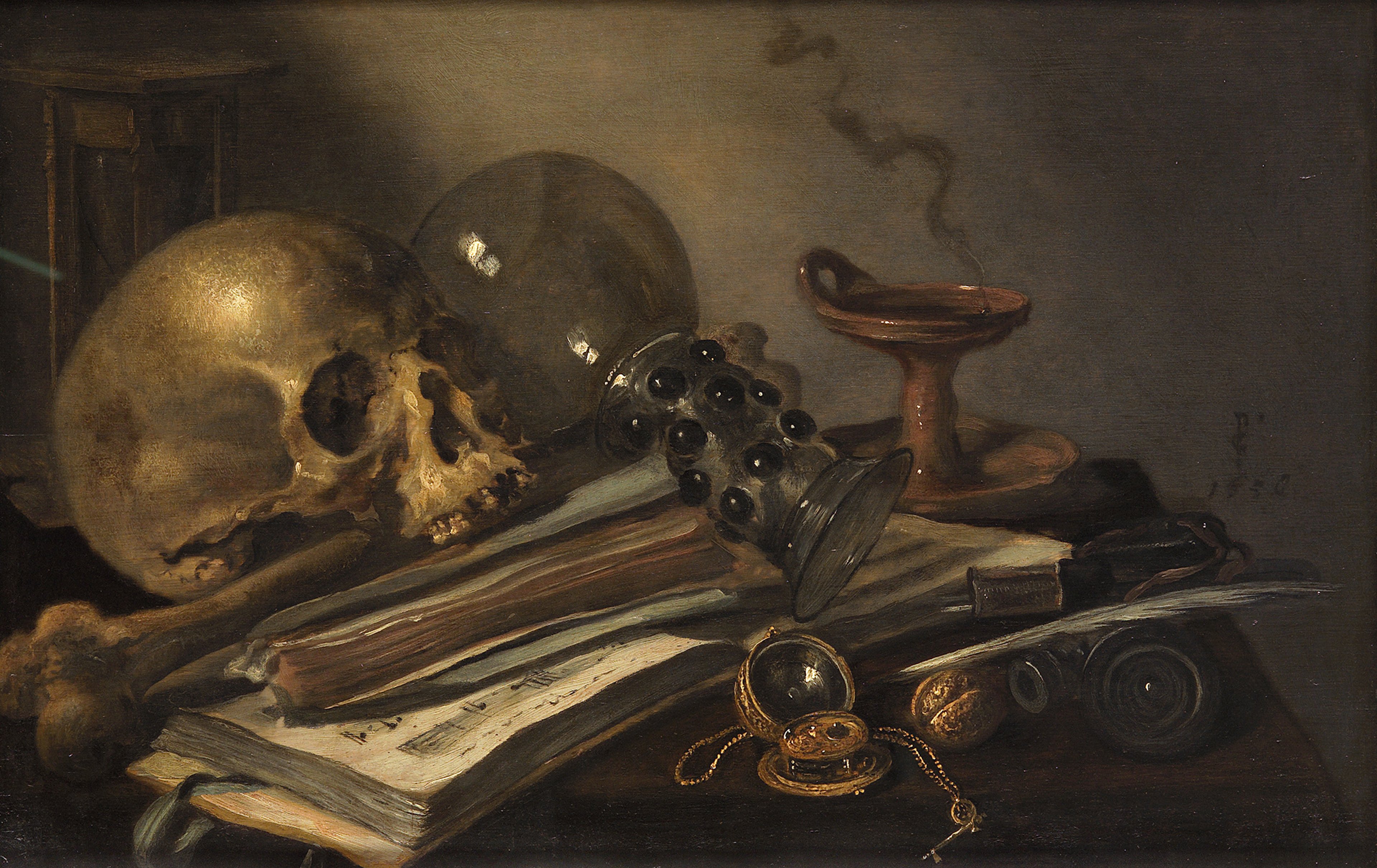
This Vanitas still life by Pieter Claesz was painted in 1656 and thus belongs to his later works. Of the 17 Vanitas still lifes by the artist known today, the later paintings depict transience and death with increasing directness and intensity.
As in his earliest Vanitas still life, the skull takes centre stage here. The Roemer glass, so characteristic of Claesz, appears in an unusual form. Rather than standing prominently on the table, as it does in his meal still lifes, it lies overturned and empty on the table, thereby becoming a symbol of transience itself. The hourglass, pocket watch, the extinguishing wick of a burnt-out candle, and the musical notation likewise point to the passage of time and the finiteness of life.
Against the backdrop of the recurring outbreaks of plague that also affected Haarlem, the painting can be read as a powerful reminder of the threat of death in Claesz’s time. At the same time, the Vanitas tradition points to the Christian hope of overcoming death.
Film Recommendation
Vanitas Still Lifes: Learn more about Vanitas symbolism in Claesz’s works.